
Preparing for a platform or ML-infrastructure loop
Design rounds now ask how you would route, split and scale LLM serving on a cluster, not only on one node. Chapter 24 runs twelve rounds with the numbers to compute and what strong answers contain.
Handbooks 02 / September 2026 / Premium PDF
Dynamo, llm-d and disaggregated serving: how to route, split, place, scale and operate LLM serving across a cluster.
Start from what a Deployment and a Service get wrong about LLM serving. Score pods on cache and load, split prefill from decode and size both pools, move the KV cache over RDMA, gang-schedule a multi-node replica, then deploy, secure, benchmark and migrate with NVIDIA Dynamo and llm-d. Twenty-five chapters, with the arithmetic worked at every step.
The complete PDF and new editions are included while your Premium membership is active. Keep the copies you download.
Already a member? Sign in to download your copy →
Read three pages before you decide
These are real pages from the PDF: how llm-d and Dynamo score pods on cache and load, why the prefill-to-decode ratio flips with the traffic mix, and how DeepSeek-V3 spreads across nodes. Each has a text version.
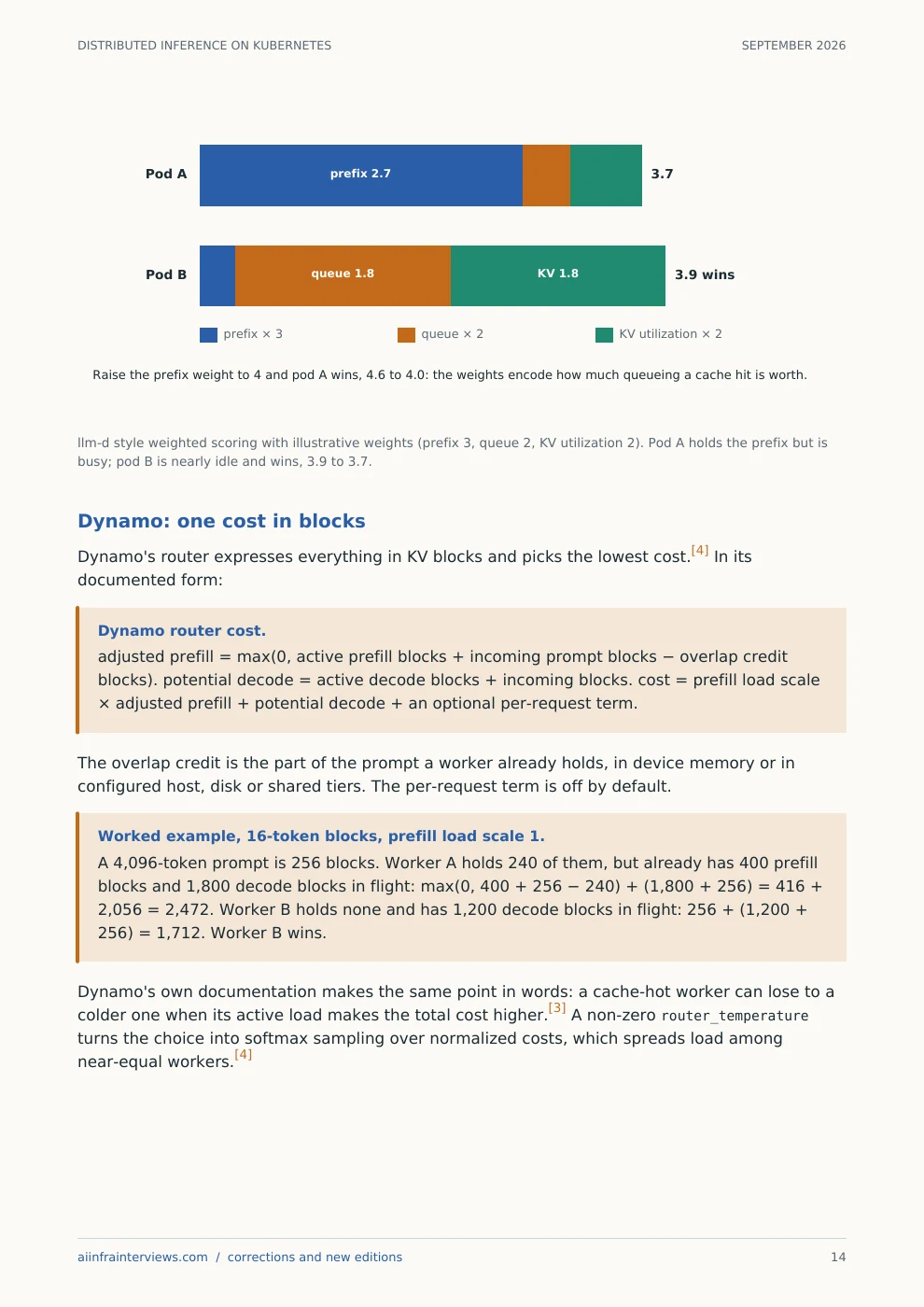
Two ways to score a pod: llm-d's weighted sum and Dynamo's block cost
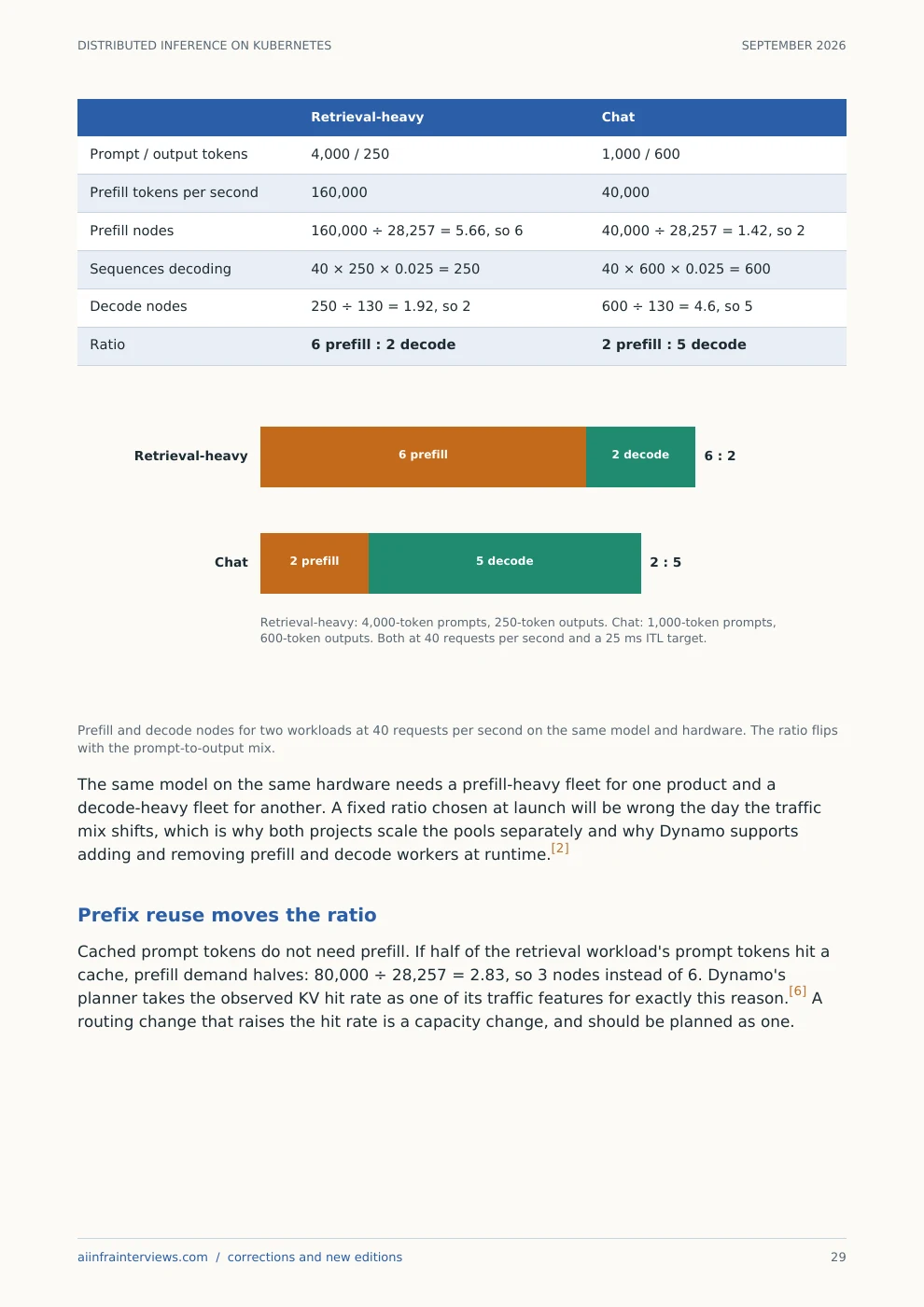
The prefill-to-decode ratio flips with the traffic mix
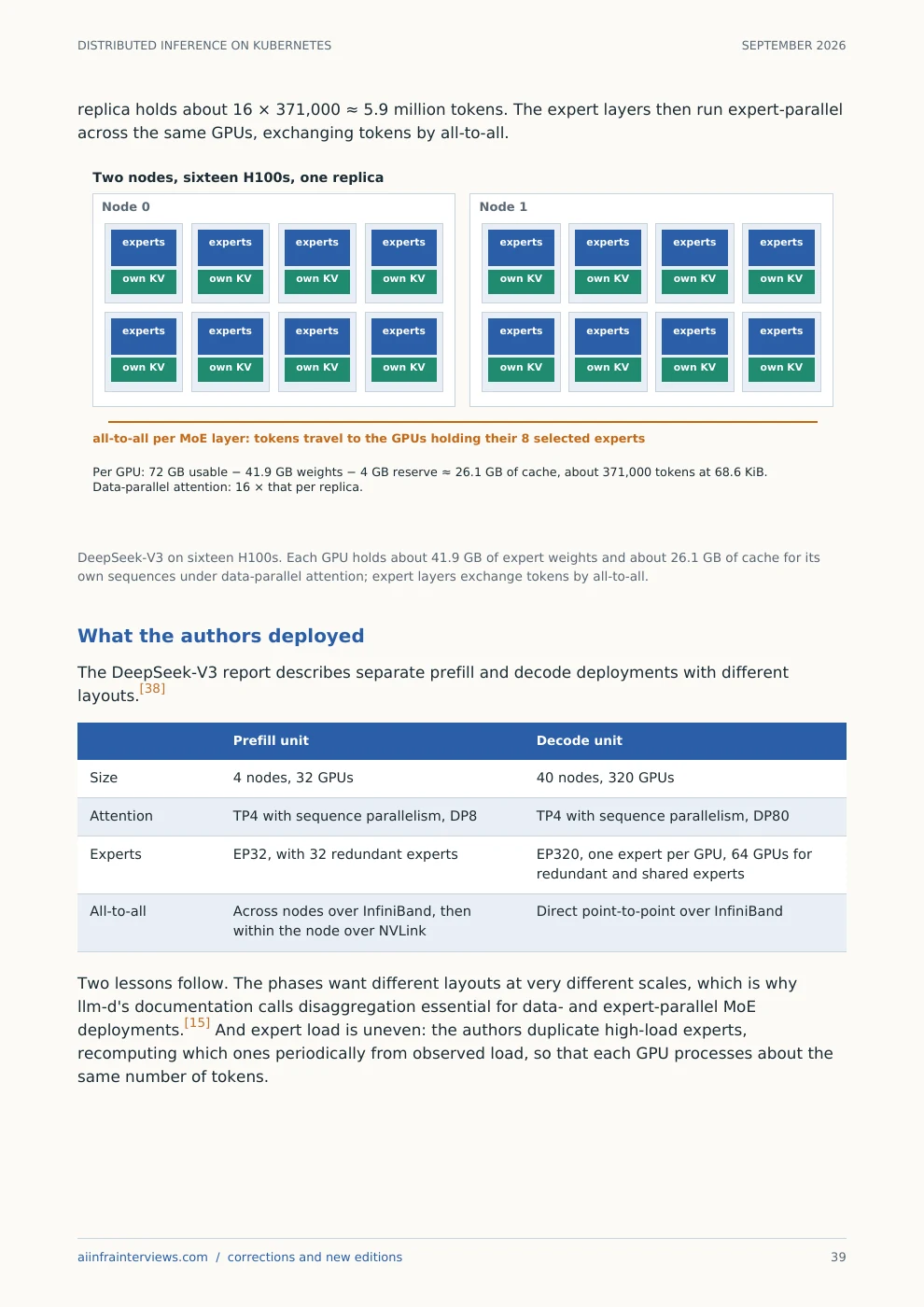
DeepSeek-V3 across two nodes, and what its authors deployed
Who it is for
Design rounds now ask how you would route, split and scale LLM serving on a cluster, not only on one node. Chapter 24 runs twelve rounds with the numbers to compute and what strong answers contain.
You know Deployments, Services and the HPA. The first chapter shows the four assumptions they make that LLM serving breaks, and the rest of the handbook builds the replacements one at a time.
Both projects are covered end to end with the same serving graph, then compared by the questions that actually decide it: engines, how much you want inside one controller, autoscaling and lock-in at the routing layer.
Debugging by symptom, the runbook, rollouts that keep rollback at the routing boundary, and the RDMA checks that stop a fabric misconfiguration from quietly turning a 3 ms transfer into hundreds of milliseconds.
Contents
A calculation from Chapter 8
A forward pass costs about 2 × 70 × 10⁹ FLOPs per token for Llama 3.1 70B. At an assumed 50 percent of eight H100s' 989 dense BF16 teraFLOPS, one TP8 node prefills 0.5 × 8 × 989 × 10¹² ÷ (2 × 70 × 10⁹) ≈ 28,257 prompt tokens per second.
At 40 requests per second with 4,000-token prompts, prefill demand is 160,000 tokens per second: 160,000 ÷ 28,257 = 5.66, so 6 nodes. Decode holds 40 × 250 × 0.025 = 250 sequences at a 25 ms inter-token target, and at about 130 sequences per node that is 2 nodes. The same model serving chat, with 1,000-token prompts and 600-token outputs, needs the ratio reversed: 2 prefill to 5 decode.
Size the cache in the KV-cache calculator → · Read the disaggregation concept →
Interview questions it prepares you for
Each prompt below has its own worked answer on the site. The handbook gives the cluster-level reasoning that connects them.
How it was made
The handbook cites 77 sources by number: NVIDIA Dynamo and llm-d documentation and release notes, the Gateway API Inference Extension specification, Kubernetes, LeaderWorkerSet, Kueue and KubeRay documentation, the DeepSeek-V3 report, and papers including DistServe, Splitwise and Mooncake. Its worked examples and self-check answers are recomputed by the build and must match the text before an edition ships.
Every chapter opens with links to the concept pages and questions that go deeper:
Request routing for LLMsDisaggregated prefill and decodePrefix cachingMulti-node serving topologiesTopology-aware communicationExpert parallelismAutoscaling and cold startsServing benchmarksInference platform architecture
Reviewed 2026-09-24. Calculations are first-order estimates with stated assumptions; no GPU benchmark was run. Manifests show the shape of a deployment; pin every version to a release you have tested. The cover is conceptual vector artwork.
Questions
The complete PDF is included with active Premium membership. Sign in, then download it from this page. You keep the copies you download, and new editions are available while your access is active. The three sample pages above are free to read.
This edition was checked against NVIDIA Dynamo v1.5.0 and its nvidia.com/v1beta1 API, llm-d v0.9.0 and its release-0.9 guides, and the Gateway API Inference Extension v1 API. Both projects move quickly, so every chapter cites the maintainer page it relies on, and the deployment chapters tell you to pin versions to a release you have tested.
It helps. The LLM Inference Systems Design Handbook explains what happens inside one engine: the KV cache, batching, scheduling and parallelism. This handbook assumes those ideas and covers running many engines on Kubernetes as one system. A glossary defines every term it uses.
No. Worked numbers are first-order calculations from published specifications and model configurations, with every assumption stated. Published results, such as llm-d's routing and cache-sharing measurements and the DistServe and Splitwise papers, are attributed to their authors with their conditions. No GPU benchmark was run for this edition.
No. The rubrics in the mock rounds describe what strong answers tend to contain. They are a study aid written for this handbook, not any company's grading criteria.
The LLM Inference Systems Design Handbook covers what happens inside one serving engine. The AI Infrastructure Field Guide builds the foundations from the first tensor to distributed systems. The AI Accelerator Field Guide compares GPUs and TPUs and is free with an account. The Open Model Field Guide covers model releases, architectures and deployment paths.